Knitting Machines
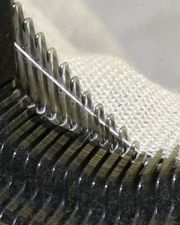
The knitting machine, sometimes called knitting frame, knitting loom, or hand knitting machine, is used to produce knit fabrics on a fixed bed of hooked needles. Knitting machines can be hand powered or motor assisted. more...
Pattern stitches can be selected by hand manipulation of the needles, or with push-buttons and dials, mechanical punch cards, or electronic pattern reading devices and computers.
There are domestic and industrial models, with either flat or circular beds that produce rectangular or tubular fabrics. Double bed machines have two flat beds facing each other, in order to produce purl and plain rib fabrics plus a variety of multi patterns. Ribbing attachments can be added to single bed machines to achieve a similar result.
Late 20th Century domestic/studio/home models typically use up to 200 latch hook needles to hold the stitches in a standard or bulky size needle. A carriage or cam box is passed across the bed of needles causing the needle movements required to produce each next stitch. By various selection methods, e.g. punch cards, particular needles can be caused to travel by alternate pathways through the cam box. Thus needles will knit or not, and the unknitted yarn portions will lie under (slip stitch) or over the needle or be held in the needle hook (tuck stitch). Needles can be placed in holding position to allow short row shaping. Most of these machines can knit two colour "fair isle" patterns automatically, and have machine stitch patterning features such as plating and knitweaving. Plating refers to knitting with two strands of yarn that are held in such a way that one is in front of the other. Plated effects can be particularly striking in a ribbed fabric. Knitweaving refers to a technique in which a separate piece of yarn, often heavier than the knitted fabric, is carried along and caught between stitches to produce an effect like weaving. With knitwoven fabric, the purl side (usually the wrong side) is the right side of the fabric. With the addition of a lace carriage, stitches can be transferred from one needle to the next. The yarn passes through a tensioning mechanism and down through the knit carriage, which feeds the yarn to the needles as they knit.
Read more at Wikipedia.org