Weaving
Weaving is an ancient textile art and craft that involves placing two sets of threads or yarn made of fiber called the warp and weft of the loom and turning them into cloth. more...
This cloth can be plain (in one color or a simple pattern), or it can be woven in decorative or artistic designs, including tapestries.
The majority of commercial fabrics are woven on computer-controlled Jacquard looms. In the past, simpler fabrics were woven on other dobby looms and the Jacquard harness adaptation was reserved for more complex patterns. The efficiency of the Jacquard loom makes it more economical for mills to use them to weave all of their fabrics, regardless of the complexity of the design.
Handweaving, along with hand spinning, is a popular craft. Weavers use wooden looms to create rugs, fabrics, and tapestries.
Fabric in which the warp and/or weft is tie-dyed before weaving is called ikat. Fabric decorated using a wax resist method is called batik.
Process
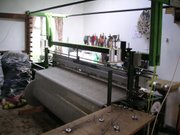
In general, weaving involves the interlacing of two sets of threads at right angles to each other: the warp and the weft. The warp threads are held taut and in parallel order by means of a loom. The loom is warped (or dressed) with the warp threads passing through heddles on two or more harnesses. The warp threads are moved up or down by the harnesses creating a space called the shed. The weft thread is wound onto spools called bobbins. The bobbins are placed in a shuttle which carries the weft thread through the shed. The raising/lowering sequence of warp threads gives rise to many possible weave structures from the simplest plain weave (also called tabby), through twills and satins to complex computer-generated interlacings.
Read more at Wikipedia.org